
Photo by Ferdy Jovanno on Pexels
Hello. It’s me.
Today I want to think about this thing called “harness” that suddenly started trending in AI agent circles. Harness, yes, harness. Not a dog collar. I’m talking about environmental design surrounding agents. Harness. This is serious business. It has a cool ring to it, doesn’t it? I want to use it more actively going forward.
So this harness concept started circulating in earnest around spring 2026, and before we knew it, people in the community had naturally segregated themselves. It’s exactly the same principle as motorcycle riders naturally dividing into American cruiser fans, sportbike replica enthusiasts, and off-road groups. There are styles, there are sects, and there’s quiet glaring of “my way is more correct.”
So I want to analyze the different types of people around harness. Along the way, I’ll add a word about how each faction affects business and development on the ground. As someone who gets consulted as a technical advisor, this tribal division has real meaning. “Which faction you align your team with” can significantly change your speed six months down the line.
Figure 1. Mapping the 7 Factions
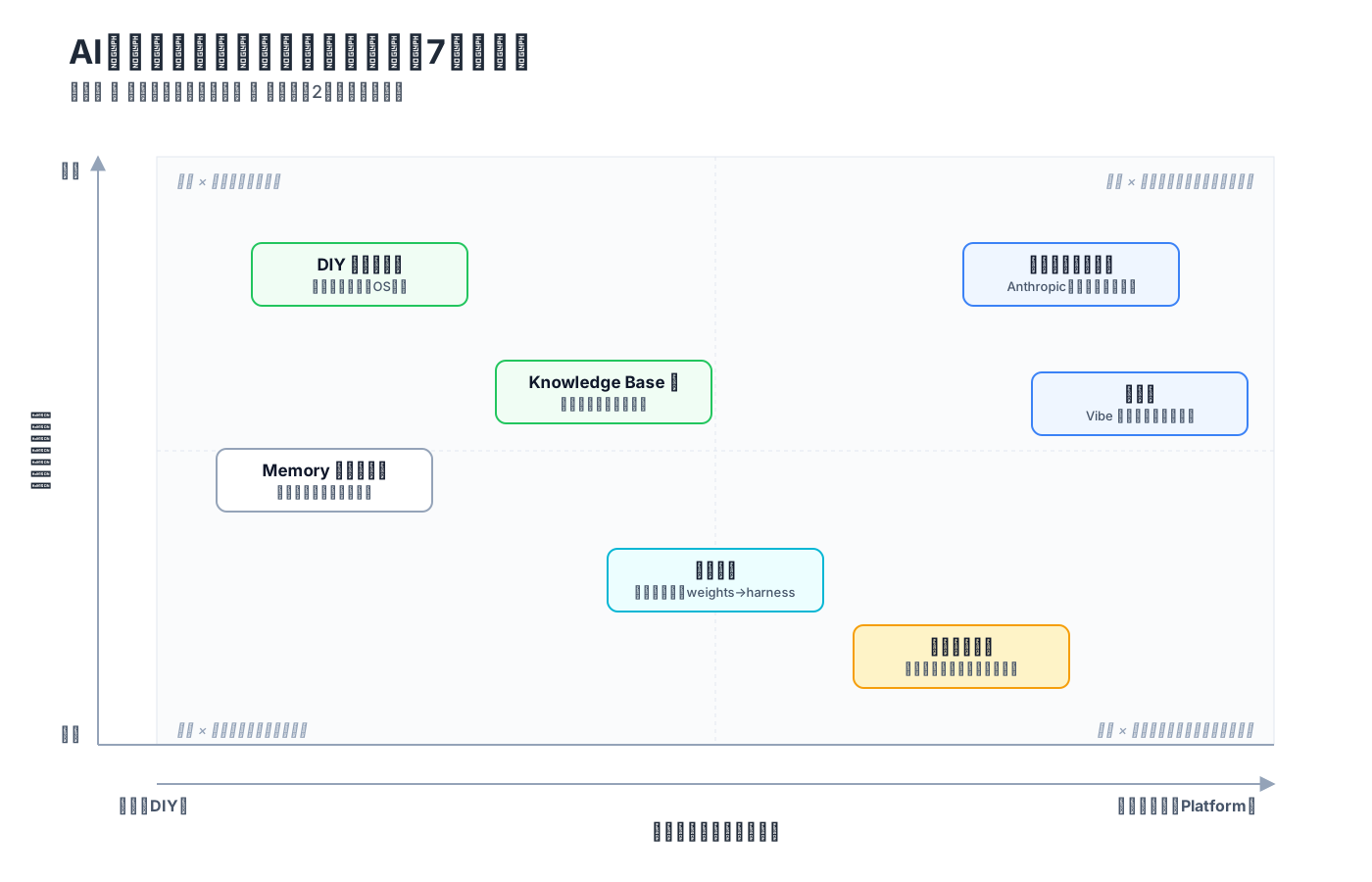
Figure 1: Placing the 7 factions on two axes: “Harness ownership style (self-built ⇄ managed)” and “Distance from debate (advocate ⇄ observer).” Use this as a guide to understand where you and your team stand.
Amateur Faction (Vibe Only)
First, let me say these people mean no harm. Really.
This is the crowd that ends their prompts with “make it feel good” and calls it a day. CLAUDE.md? What’s that, is it tasty? Hooks? MCP? Skills? It all sounds like magic spells to them. They get angry when output doesn’t work on the first try. I get it, I get angry too—actually I get angry every day.
But talking to these people about harness design will only make them look up at the sky, so you should stop. They’re adorable. They mean no harm. They’re truly innocent.
Decision Point: It’s not necessarily bad for non-engineer executives to stay here. In fact, the strength to create internal tools yourself through Vibe Coding is real. The problem is the “evolution stops” phase that comes the moment you put it into production. The dividing line is whether you have a system where someone can take over the harness when that timing comes.
Official Managed Faction (Anthropic Believers)
This one’s easy to understand. What the official provides is justice. That’s it.
Managed Agents, Remote Control—they go all-in on everything official. They say building your own infrastructure is a waste of time. That’s correct. It really is correct. It’s faster to rent a finished box than to build a garage from scratch.
But you know.
These people started expressing that harness itself becoming a managed service as “meta-harness” with newly coined terminology, and when I heard this, I thought “ah, I see” while simultaneously being enveloped in a feeling of “somehow…” despair. I look at people who can write about migrating from self-built harness to managed over a weekend with a mix of respect and mild jealousy. Damn.
Decision Point: For startups or teams before business launch, leaning toward official managed first is faster. You should start building your own harness “when your company’s unique business knowledge or security requirements can’t be expressed within official defaults.” Get the order wrong and you’ll end up maintaining harness before your core business.
DIY Harness Faction (Handmade Hardcore)
This is the most intense.
These are the people who write settings.json, refine CLAUDE.md, embed Hooks, and organize Skill files in perfect order. They read 70,000-character implementation records as sacred texts. 70,000 characters. That might be more than the total characters of all the love letters I’ve written in my life. Not that I’ve written any. That’s irrelevant.
These are people who can organize and articulate the evolution diagram of “prompt engineering → context engineering → harness engineering.” The model is the CPU, the harness is the OS. If the OS sucks, it doesn’t matter how fast the CPU is. Correct. Perfectly correct.
There are stories of just improving harness with LangChain taking Terminal Bench scores from Top30 to Top5, and when I heard this I involuntarily said “no way.” I really said it. As a monologue. Alone in my room.
Decision Point: If your company’s competitive advantage lies in “being able to completely delegate work flows that other companies can’t handle to LLM,” then the DIY faction’s knowledge is seriously worth pursuing. On the other hand, you should return to sanity about once a month to check whether continuously polishing harness has become an end in itself.
Knowledge Base Fundamentalist Faction (Circulation Believers)
These are people who dump materials into raw/ folders, wikify with LLM, do Q&A, create deliverables, and reflect back into the wiki—running this grand circulation of knowledge.
What’s amazing about this faction is the reaction speed of believers. 48 hours after the proponent posts, tools sprout on GitHub. Tools that turn arbitrary folders into knowledge graphs with one command. By the time I finish reading an article thinking “huh, interesting,” someone somewhere in the world is already running it.
People saying “you can build it in 30 minutes” start appearing. 30 minutes. I sometimes fail at making cup noodles in 30 minutes. I forget to boil the water.
Then comes the observation that “what’s groundbreaking isn’t each function, but the circulation where the knowledge base itself gets continuously edited,” and reading this, I finally felt I understood the essence of this faction. It’s not about creating a static knowledge storage place, but creating a system where knowledge grows itself.
Decision Point: The more an organization has personalized business knowledge, the more this faction’s thinking works. However, if you introduce it without deciding “who’s in charge of running the circulation,” you end up with the pattern of just throwing materials into raw/ and calling it done. I think it’s about deciding who owns it before the system.
Cold Observer Faction (Tribal Division Watchmen)
These people are the scariest.
While everyone’s excited about harness design, they quietly say “but everyone’s just using Claude Code in the end, right?” That’s right. Does a market for creating good-performance harness really exist? It’s a cool observation that by the time you’re done, the main company will have taken everything. “Don’t pick the wrong market to compete in.”
When I read this, I thought “ugh.” It’s completely correct, but the kind of correctness I didn’t want to be told.
They even organize the division between RAG and agentic search, with the articulation that “converting .doc and .pdf to .md, using LLM to trim old parts and duplicates, and compressing to a size that fits in the agent’s view—this grand spring cleaning is 2026’s Agentic DX.” Grand spring cleaning. Great naming.
Decision Point: If you’re selling harness as your own product, you need to answer this faction’s cold questions first. “If the main company releases the same thing six months from now, what will make your product survive?” Conversely, for internal harness, you can ignore this question—you can just switch when the main company releases the same functionality. The decision axis changes between internal vs product.
Memory Independence Faction (Lock-in Warning Group)
Entrusting harness to specific services means handing over memory management rights to third parties. That’s the story.
Memory determines the quality of your agent experience. Therefore both memory and harness should be open. You should own your own memory.
…This is a very serious topic, but when I heard “memory ownership,” I momentarily thought “my memory has nothing in it.” Not even a knowledge graph—I can’t remember what I had for dinner yesterday.
Decision Point: In enterprise consultations, this almost always becomes a topic. The “is it okay to put our business knowledge inside Anthropic (or OpenAI)” problem. Rather than the technology selection itself, checking whether memory can be maintained on the company side in both contract and architecture terms is ultimately the most effective checkpoint, I think.
Evolution Theory Faction (Three-Stage Historical View)
weights → context → harness.
2022 was the era of making models themselves smarter. 2024 was the era of making context smarter. 2026 is the era of making the environment surrounding models smarter. This evolution diagram is simple and beautiful, but being too beautiful makes it conversely suspicious. Does the world really divide so cleanly into three stages?
But I understand the flow that “polishing prompts has limits, and the next layer is harness” from experience. When I think something isn’t working well, I’ve had several experiences where it wasn’t actually a prompt problem but a design problem.
Decision Point: When your team has “LLM isn’t working well” discussions, just first dividing “is this a prompt problem, context problem, or harness problem” changes the quality of discussion. Even if the three-stage historical view is half religion, it’s practical as a problem classification framework.
So, What Should We Actually Do?
Anthropic released managed services. Someone called it lock-in. Someone else said the main company would take the entire harness market. Someone else said to cultivate knowledge circulation. Everyone says different things, and everyone is somewhat right.
As for me, I found all the stories interesting and kept reading articles until it was 3 AM. Sleep management might have been more important than harness.
However, from my position actually receiving consultations as a technical advisor, I think the practical decision axes extractable from this observation report are surprisingly simple.
- Choose by phase: Lean toward official managed during launch. Consider DIY after entering differentiation phase.
- Choose by purpose: Internal vs external product. Only the latter needs to answer the cold observer faction’s questions.
- Choose by owner: If running knowledge circulation, decide the owner first. People before systems.
- Choose by portability: Can you maintain memory on the company side? This has long-term impact.
People who talk about harness are viewing the world from their respective layers. That’s why identifying which layer your team is currently struggling with might be more important than choosing factions.
Thank you for reading this far.
At mak246.com, we organize practical knowledge at the intersection of AI agent design and business decisions from a field perspective. Read together with the previous What is Harness Theory in LLM? Understanding the Essence of Agent Design through Minecraft, you should get a clearer view of the overall harness picture from both “theory” and “field factions” sides.