What is “Harness Theory” in LLMs?
Why “Systems That Work Well” Matter More Than Smart Models: A Minecraft Perspective
Recently, LLMs have been getting smarter and smarter.
They write text. They summarize. They write code. They answer questions.
For these single-shot tasks, they’ve already reached quite high standards. However, when you try to actually get LLMs to “do” something, you encounter a different wall.
Things look promising at first, but then the approach wavers midway. For long tasks, they forget the premise. They can’t recover after failure. They can’t reuse approaches that worked before.
In short, they seem smart but don’t complete work as a job.
In this article, we’ll explore a perspective for understanding this problem: “Harness Theory” in LLMs. This is the idea that LLM strength is determined not by the model alone, but by what kind of system connects it to the world, remembers, tries, and recovers from failure.
And Minecraft turns out to be a surprisingly compatible subject for understanding this concept.
1. Being “Smart” Isn’t Enough for LLMs
When discussing LLMs, we tend to focus on “which model is the smartest.” Of course, that’s important.
However, for actual tasks, that alone isn’t sufficient.
For example, when someone asks a human to “build a house,” they naturally think about:
- What’s currently where
- Are there enough materials
- Where to build it
- Are there any dangers
- What to do if something fails midway
- How much progress to make today
However, when you simply tell an LLM “build a house,” while it might return a plausible plan, it tends to get stuck when it comes to actual action. This is because real tasks require functions beyond thinking.
- Observing the current state
- Remembering progress
- Using tools as needed
- Recovering from failure
- Resuming from where you left off
- Reusing successful approaches
Without strong “infrastructure,” no matter how smart the model is, it won’t demonstrate execution capability.
2. What is a Harness?
The word “harness” originally refers to horse gear or safety equipment. In the LLM context, it’s roughly:
A framework that connects the model to real tasks and enables it to work properly
If the LLM itself is the “brain,” then the harness is what enables that brain to operate in the real world, providing:
- Eyes
- Hands
- Working memory
- Procedures
- Logs
- Checklists
- Retry mechanisms
An LLM alone can provide seemingly intelligent responses. But to complete work, it needs a solid execution foundation around it.
Anthropic points out that in designing long-running agents, LLMs tend to experience memory fragmentation across multiple sessions, and simply having a smart model isn’t enough to stably progress through long tasks. They explain the agent harness as a framework to compensate for this.
Figure 1. Overall View of Harness Theory
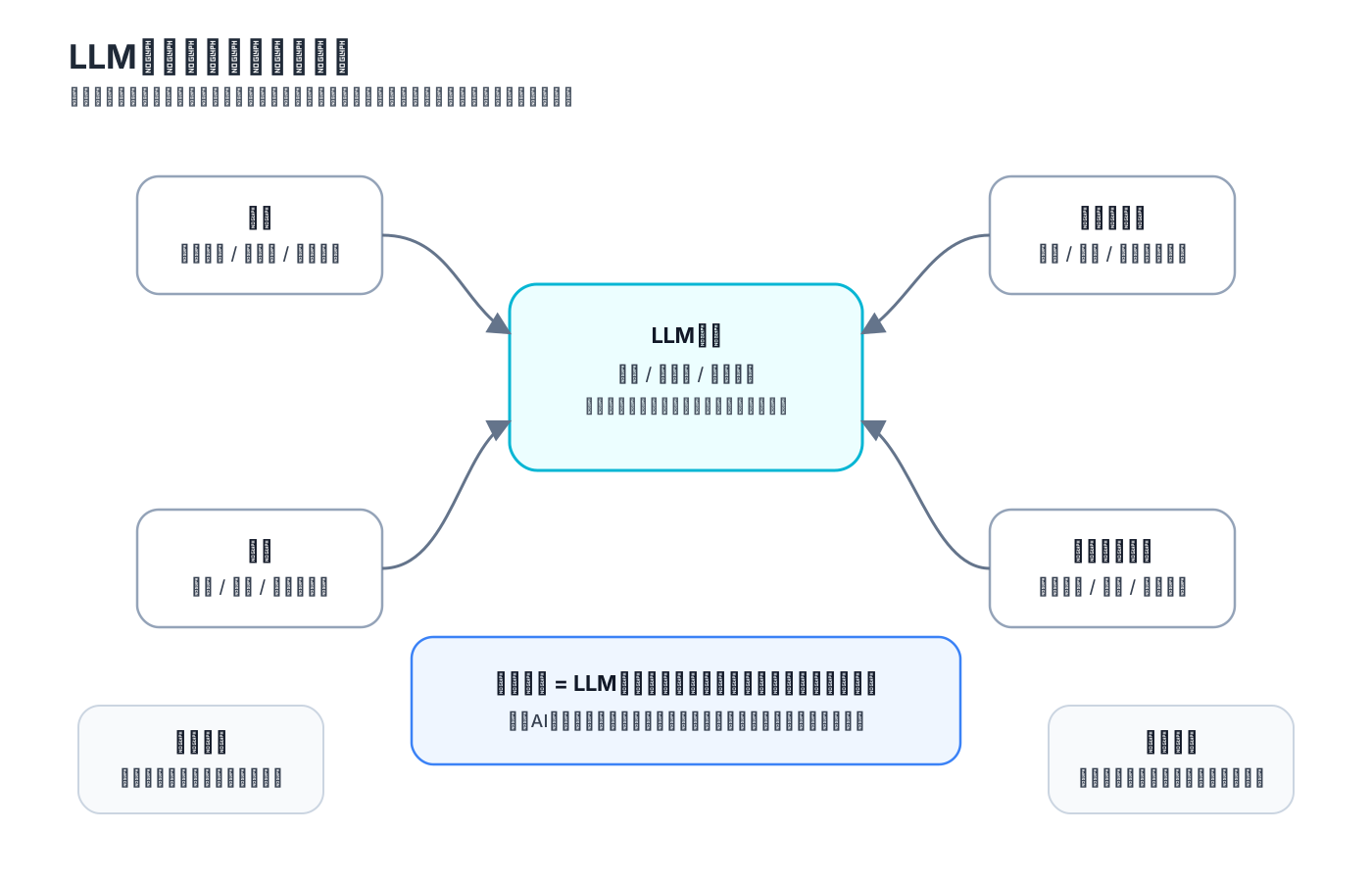
Figure 1: Overall diagram showing that the “harness” encompasses not just the LLM alone, but the entire execution foundation including observation, memory, tools, and retry mechanisms.
3. Why Minecraft is the Perfect Example
Minecraft is an excellent subject for explaining this concept. This is because in Minecraft, “just thinking” doesn’t get you anywhere.
Gather wood. Make tools. Secure food. Build a base. Survive the night. Avoid danger. Mine when necessary.
All of these require making decisions based on the situation as you progress.
What’s interesting about Minecraft is that tasks aren’t linear.
Even for building a house:
- Should you look for wood first?
- Should you gather stone first?
- Should you make a temporary shelter before nightfall?
- Should you secure food first?
The order changes depending on the situation.
Moreover, the world state is constantly changing:
- Where are you now?
- What’s in your inventory?
- Are there enemies nearby?
- How long until sunset?
- Where is the base you built before?
Without acting based on this information, you’ll quickly fail.
That’s why Minecraft very clearly demonstrates LLM’s fundamental weaknesses and the importance of harnesses.
Voyager, as an LLM agent operating in Minecraft, demonstrated open-ended exploration and long-term growth by combining automatic curriculum, skill library, and iterative improvement using environment feedback.
4. The Difference Between Weak and Strong LLMs Through “Building a House”
For example, let’s say you ask an LLM to “build a house” in Minecraft.
When the Harness is Weak
In this case, the LLM will probably say something plausible:
“First I’ll gather wood. I’ll make a workbench. I’ll collect the necessary blocks and build a house.”
The text is correct. But in practice, it’s quite precarious:
- Is there even wood nearby?
- Is it day or night?
- Are there enemies?
- Do you have an axe?
- Is there space in the inventory?
- Is the building location safe?
Proceeding without considering this information leads to getting stuck. Moreover, if the reason for getting stuck isn’t logged, the same failure will repeat next time.
When the Harness is Strong
On the other hand, when the harness is strong, the same “build a house” request results in different behavior.
First, it observes the current state:
- Inventory items
- Surrounding terrain
- Time of day
- Presence of enemies
- Candidate building sites
Then it proceeds:
- Retreat if dangerous
- Collect materials if insufficient
- Call existing skills if needed
- Record the cause if it fails midway
- Save progress
- Resume from where it left off next time
At this point, it becomes a system that actually does work rather than just “smart-sounding responses.”
Figure 2. LLM Harness Execution Flow in Minecraft
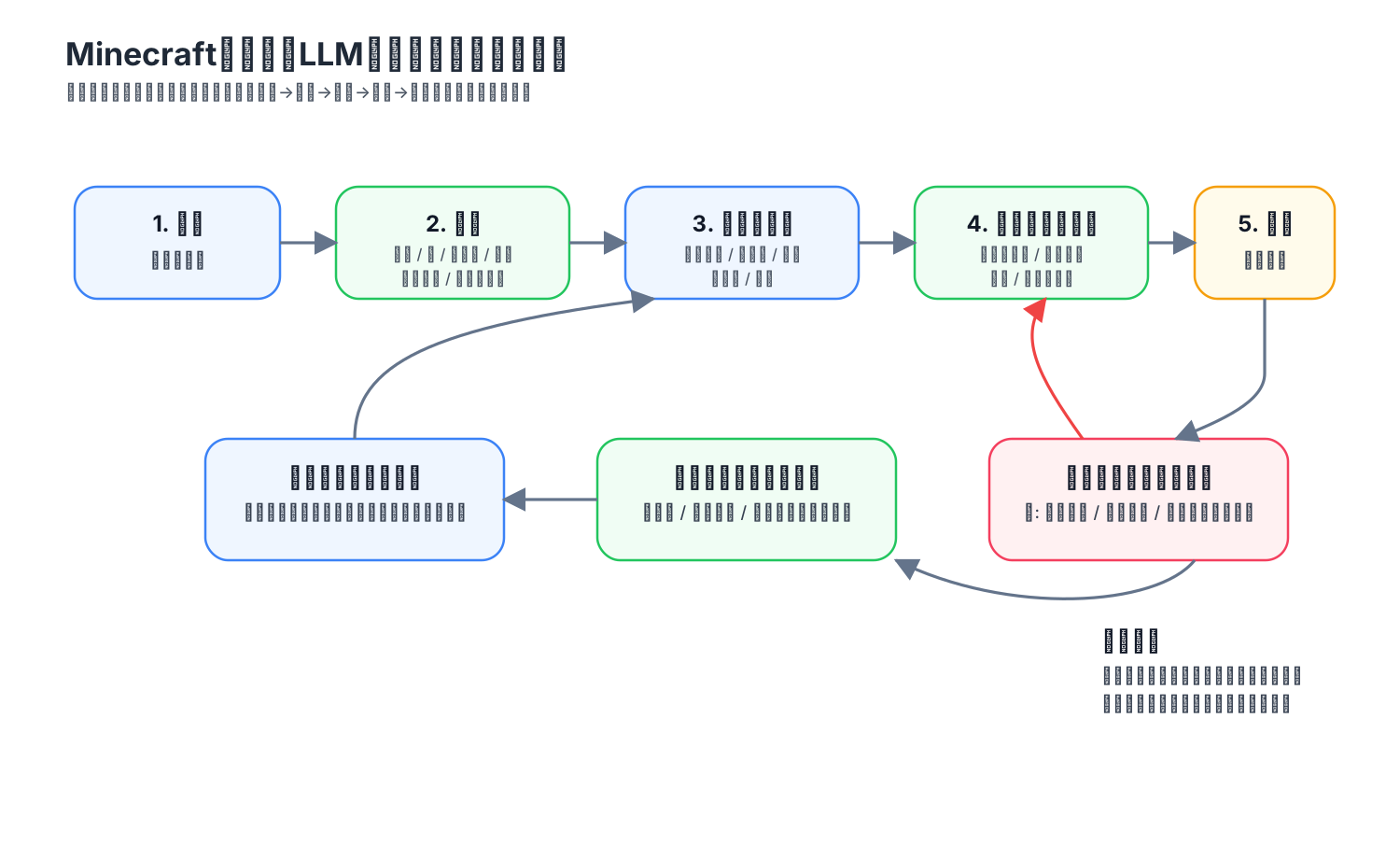
Figure 2: How the vague goal of “build a house” is converted into an observable, decomposable, executable, recordable, and resumable workflow.
5. Four Roles of Harnesses Visible in Minecraft
Using Minecraft as an example, the roles of harnesses can be easily divided into four categories:
5-1. Observe
First, you need to properly read the current world state.
Where is the wood? Are there enemies nearby? Do you have food? Is it getting dark? Is your current location safe?
Obviously, you can’t respond to what you can’t see. It’s not that the LLM is weak, but rather weak observation means prevent it from demonstrating intelligence.
5-2. Remember
Next, you need to carry state forward:
- Base coordinates
- Chest contents
- How far you progressed last time
- Routes that failed before
- Frequently used building procedures
Without this, you start from zero every time.
MineNPC-Task, which evaluates memory-aware agents in Minecraft, also treats memory read/write and consistency of planning, action, and recovery as important evaluation criteria.
5-3. Reuse Skills
There’s no need to think about “how to gather wood” from scratch every time. Procedures that worked once should be reusable. This is skill reuse.
In Minecraft, these actions become powerful when modularized:
- Safely gathering wood
- Making a stone pickaxe
- Returning to base without getting lost
- Building minimal shelter
Voyager accumulates successful actions as a reusable skill library that can be applied to new challenges.
5-4. Recover from Failure
This is quite important.
For LLMs, the pain isn’t so much that they fail, but that they can’t leverage failure for next time.
You tried to cut wood but failed. What was the reason?
- No axe
- Couldn’t see the wood
- It was night and dangerous
- Inventory was full
- Wrong target entirely
Whether you can incorporate this failure as a cause rather than ending with “it failed” - this is where harness differences show.
Recent modular harness research also shows that configurations separating perception, memory, and reasoning in game environments are effective and lead to more stable performance improvements than simple one-shot inference.
6. The Essence of Harness Theory is “Externalizing Intelligence”
This is the main point I want to make in this article.
When LLMs don’t work well, we tend to think “let’s switch to a smarter model.” Of course, that sometimes leads to improvement.
But there’s actually another significant approach: Moving part of the intelligence outside the model.
For example:
- Place memory in external storage
- Keep state as logs
- Decompose actions into tools
- Break long goals into small tasks
- Save successful procedures as skills
- Verify outputs with checkers
This way, the model itself doesn’t have to handle everything.
This isn’t about “babying the model.” It’s the opposite - it’s a design that lets the model focus on what it’s truly good at: reasoning and language generation.
OpenAI’s Agents SDK also adopts a design that connects models with the outside world through tool connections like Web Search, File Search, Code Interpreter, and MCP. This can also be viewed as a harness implementation.
7. The Minecraft Story Directly Applies to Business AI
Reading this far, you might think “that’s just about games.” But it actually translates quite directly to business applications.
Gathering wood in Minecraft is like collecting necessary information in business. Making tools is like preparing templates and scripts. Returning to base is like restoring previous state. Learning skills is like modularizing reusable procedures. Learning from failure is the logging and improvement mechanism itself.
So when using LLMs in business, the real question isn’t just “which model is the smartest?”
Rather, what should be considered first is:
- What can be observed?
- Where will state be stored?
- How to resume from where you left off?
- How to reuse successful procedures?
- How to detect and correct failures?
Without strong design in these areas, no matter how high-performance a model you deploy, it will remain unstable in practice.
Figure 3. Correspondence Between Minecraft and Business AI
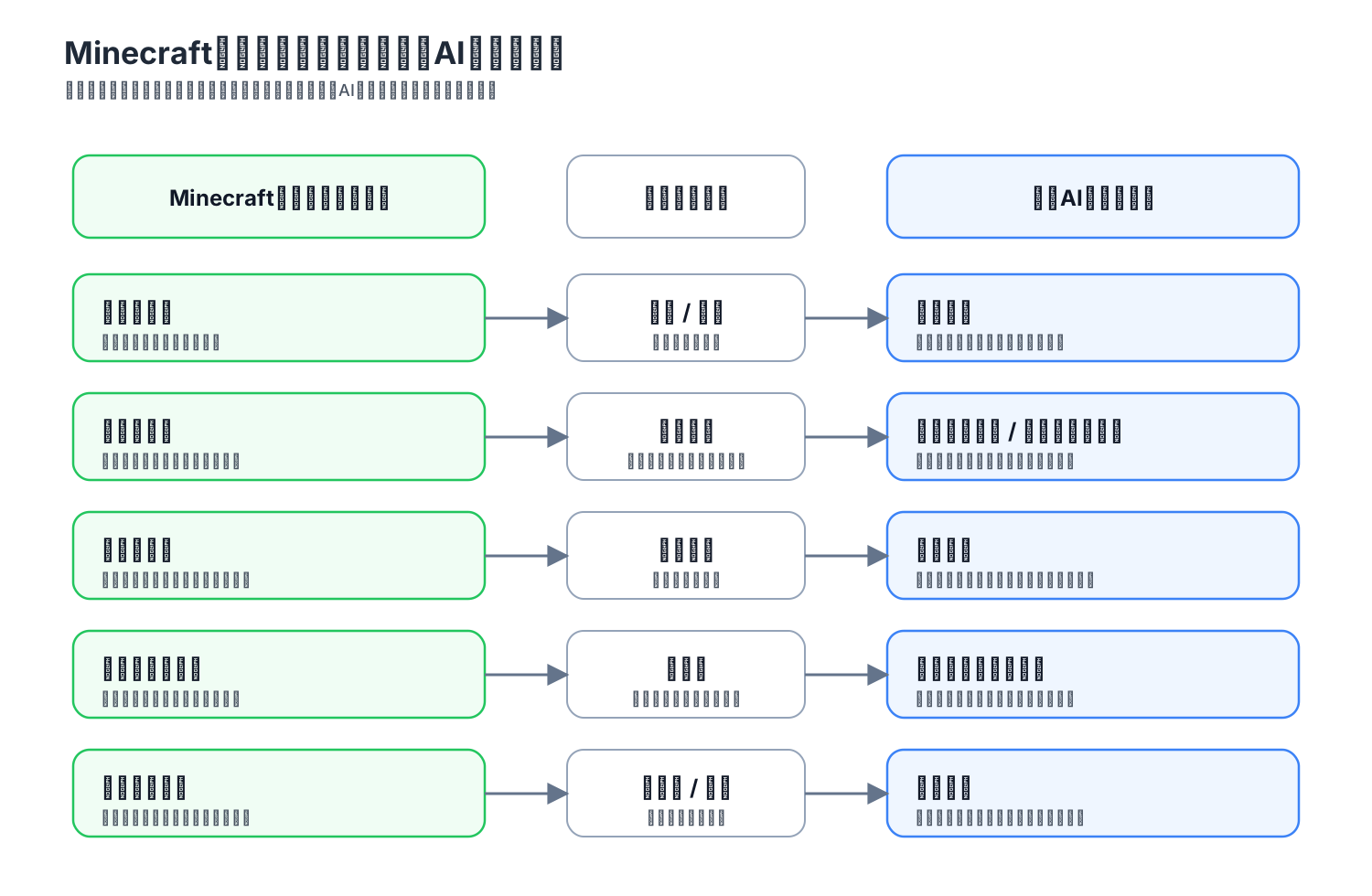
Figure 3: Correspondence diagram showing how Minecraft actions directly map to business AI design elements.
8. Summary
In the LLM era, we tend to focus only on model performance itself. But for building AI that actually “works,” that’s not the only important factor.
Minecraft makes this very clear.
What strong agents need is:
- Ability to observe the world
- Ability to remember state
- Ability to reuse skills
- Ability to recover from failure
- Ability to carry progress forward over long time periods
In other words, LLM strength isn’t determined by model intelligence alone. It’s determined by what kind of harness operates it.
This is what I call “Harness Theory in LLMs” in this article. And Minecraft is a world that demonstrates this essence very clearly.
References
- Anthropic, Effective harnesses for long-running agents (2025)
- Wang et al., Voyager: An Open-Ended Embodied Agent with Large Language Models (2023)
- Doss et al., MineNPC-Task: Task Suite for Memory-Aware Minecraft Agents (2026)
- General Modular Harness for LLM Agents in Multi-Turn Gaming Environments (2025)
- OpenAI Agents SDK Tools Documentation
Thank you for reading this far.
What I wanted to convey in this article is that when considering LLM utilization, we need to design not just the model’s standalone performance, but also how to make that model work.
Going forward, when designing business AI or AI agents in earnest, what deserves attention isn’t just “which model to use,” but:
- What information to observe
- Where to store state
- How to enable retries
- How to modularize successful procedures
This is the harness design itself.
At mak246.com, we organize practical knowledge at the intersection of management, business, and development from a field perspective. If you have similar interests, please check out our other articles.